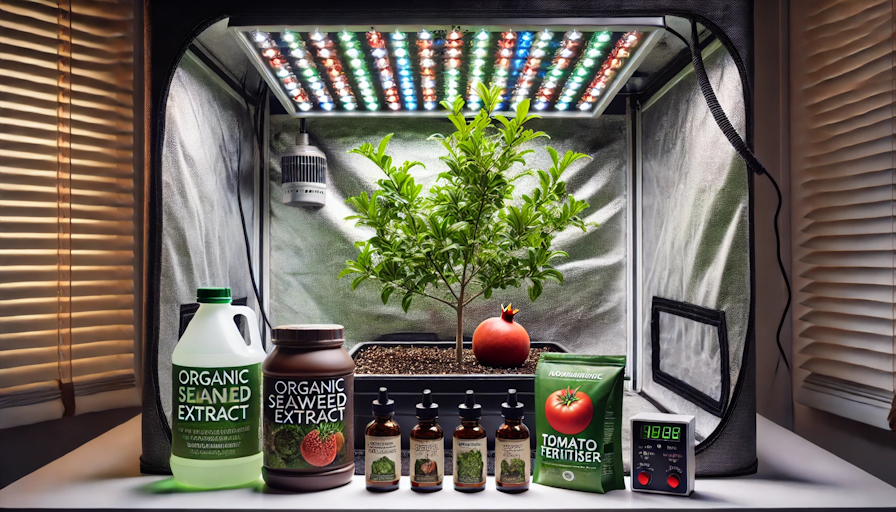
In a recent article we explored plants you can grow in a grow tent, and one option that caught our eye was a pomegranate tree. Inspired, we decided to start our own. We brought a handful of seeds back from a recent trip to Montenegro and were keen to grow them here in the UK (no international smuggling involved!). A grow tent gives us full control over light, temperature and humidity, which makes it an excellent nursery for a young pomegranate during its early, tender years.
This guide takes you all the way from preparing the seed to caring for an established sapling, and it is honest about what a grow tent can and cannot do for this particular tree. Read it once before you start and you will avoid the three most common mistakes: feeding the wrong fertiliser, drowning the roots, and never giving the tree the winter rest it quietly needs.
Before you begin, set your expectations. Most shop-bought and eaten pomegranates are hybrids, so a seed-grown tree will not necessarily produce fruit identical to the parent, and the fruit may be smaller or more tart. Seed-grown trees also take roughly three to six years to fruit, sometimes longer, and a few never fruit well indoors. Grow it for the journey, the foliage and the beautiful orange-red blossom, and treat any fruit as a bonus.
At a Glance
| Botanical name | Punica granatum |
| Germination temperature | 24 to 29°C (75 to 85°F) |
| Germination time | 2 to 4 weeks (sometimes up to 6) |
| Growing temperature | 20 to 30°C (68 to 86°F) |
| Humidity | 50 to 60% for seedlings, 40 to 50% once established |
| Light | Full-spectrum LED, 14 to 18 hours per day |
| Soil | Free-draining, sandy or loamy, neutral to slightly alkaline (pH 6.5 to 7.5) |
| Time to fruit from seed | 3 to 6 years (variable, not guaranteed) |
Step 1: Extracting and Preparing the Seeds
Good preparation is what separates a tray of healthy seedlings from a tray of mould. The flesh around each seed (the aril) is the part you eat, but if any is left on the seed it will rot and ruin germination.
- Choose a ripe, healthy fruit. Pick the biggest, firmest, undamaged fruit you can. Larger, sweeter fruit gives you a slightly better chance of a worthwhile seedling.
- Remove the seeds and clean off every trace of flesh. Rub the seeds firmly in a paper towel, or pop them in your mouth to strip the flesh, then rinse well. The clean seed underneath is small, pale and angular, with one pointed end where the root emerges.
- Dry them. Spread the seeds out and let them air-dry for at least 30 minutes, ideally a few hours. This reduces the risk of mould once sown. Do not let them dry out completely for days on end, as that can cost you viability.
- Optional but recommended, cold stratify. Pomegranate seeds do not strictly need a cold spell, but a short chill improves and evens out germination. Wrap the clean, dry seeds in a barely-damp paper towel, seal in a labelled bag, and leave in the fridge for four to six weeks.
- Optional, a 24-hour soak. The seed coat is hard. If you skip stratification, soaking the seeds in warm water for 24 hours before sowing helps soften the coat and speed things up.
Step 2: Sowing
How you sow makes a real difference to your strike rate, so it is worth getting right.
- Medium: use a free-draining seed or potting mix lightened with coarse sand, grit or perlite (roughly two parts mix to one part sand). Pomegranates hate sitting in wet compost.
- Containers: small pots or modular trays. Biodegradable pots are ideal because pomegranates form a taproot that resents disturbance when you pot on.
- Depth: sow each seed about 0.5 to 1cm (a quarter of an inch) deep and cover lightly. Do not firm the soil down hard.
- Warmth: keep the medium at 24 to 29°C (75 to 85°F). A heat mat under the tray makes germination faster and far more reliable in a UK room.
- Humidity: cover with a propagator lid or clear bag to hold moisture, and keep the mix damp like a wrung-out sponge, never soggy.
- Light: seeds do not need light to germinate, but the moment seedlings break the surface, remove the cover to prevent damping off and move them under your grow light.
Expect sprouting in two to four weeks, occasionally longer. Germination is often uneven, so do not bin a tray too early.
Step 3: Setting Up the Grow Tent
Once seedlings have their first true leaves, the grow tent comes into its own. Three things matter most: light, climate and air movement.
Lighting Schedule
Pomegranates are sun-lovers and need plenty of light to grow sturdy rather than spindly. Use a full-spectrum LED grow light and keep it at the manufacturer’s recommended distance, raising it as the plant grows so leaves do not scorch or stretch.
| Stage | Age | Light Hours per Day |
|---|---|---|
| Seedling | Weeks 1 to 6 | 14 to 16 hours, gentle intensity |
| Early Growth | Weeks 6 to 12 | 16 to 18 hours |
| Vegetative (year one) | Months 3 to 12 | 14 to 16 hours |
You will see “bloom” lighting modes mentioned elsewhere, but there is no point switching to a bloom schedule in year one because the tree is far too young to flower. Keep it in vegetative growth and focus on building a strong root system and framework.
Temperature and Humidity
Pomegranates thrive between 20 and 30°C (68 to 86°F) during active growth. Seedlings appreciate slightly higher humidity at around 50 to 60%; once established, drop this to a moderate 40 to 50%. Avoid wild temperature swings, which stall growth.
Ventilation (do not skip this)
A sealed, warm, humid tent is a perfect breeding ground for fungal problems and sap-sucking pests. Run an extractor or clip fan to keep air moving gently across the foliage. Good airflow also strengthens the stem, giving you a tougher, stockier little tree.
Step 4: Watering and Feeding
Watering
Pomegranates like a deep soak followed by a dry-out. Water thoroughly, then wait until the top 2 to 3cm of compost feels dry before watering again. They tolerate drought far better than waterlogging, and soggy roots are the quickest way to kill a young one through rot. Scale watering back over winter (see the dormancy section below).
Feeding
A young, non-flowering tree spends its first year growing leaves, stems and roots, so it wants a balanced or slightly nitrogen-leaning feed, not a high-potassium tomato feed such as Tomorite. Tomorite is designed to push flowering and fruiting, which is the wrong signal to send a seedling. Save it for years two or three onwards, once the tree is actually in flower.
| Stage | Age | Feed & Application |
|---|---|---|
| Seedling | Weeks 1 to 6 | Little to none. If your mix is low in nutrients, a quarter-strength Vitax Organic Liquid Seaweed tonic every two weeks supports root development. |
| Early Growth | Weeks 6 to 12 | Half-strength balanced all-purpose feed (such as Miracle-Gro All Purpose) every two weeks for foliage and branch development. |
| Vegetative (year one) | Months 3 to 12 | Full-strength balanced feed roughly every two to four weeks. Ease off feeding from late autumn as the tree slows down. |
Less is more with a seedling. Overfeeding causes soft, sappy growth that flops and attracts pests.
Step 5: Potting On, Training and Pruning
- Pot on gently. When roots fill the starter pot, move up one size at a time into a free-draining mix. Disturb the taproot as little as possible, which is why biodegradable starter pots are handy.
- Watch for leggy growth. Even under good lights, indoor pomegranates can stretch and become spindly. Pinch out the growing tips to encourage bushier, branching growth.
- Decide on a shape. You can train it as a single-trunk tree or as a multi-stemmed bush. For a tent or container, a compact multi-stem or even a bonsai-style form is easiest to manage.
- Prune sparingly. Pomegranates flower at the tips of new shoots, so heavy pruning later on removes next season’s blossom. In year one, light tip-pinching for shape is all that is needed.
Step 6: The Winter Rest (the Bit Everyone Forgets)
Here is the single most important thing to understand about pomegranates under cover: they are deciduous and naturally want a cool, restful winter. In a grow tent kept warm and brightly lit all year round, the tree never properly slows down. The result is weak, leggy growth, and over time poorer flowering once the tree is old enough to bloom.
In year one, when the tree is purely vegetative, keeping it growing is acceptable if you want maximum size. But from the second winter onwards, give it a genuine rest:
- Reduce the light hours and the temperature in late autumn.
- Move it somewhere cool but frost-free, ideally around 5 to 10°C (40 to 50°F). A pomegranate will only drop fully dormant below roughly 4°C (40°F).
- Water sparingly through winter, just enough to stop the rootball drying out completely.
- It is normal and healthy for the leaves to yellow and drop. Resume normal watering and feeding as growth restarts in spring.
Hardier pomegranate cultivars can shrug off temperatures down to around minus 10°C (12°F) once established, but young potted trees are far more tender, so frost-free is the rule.
Step 7: Pollination and Fruit Production
Fruiting is a years-two-to-six concern, not a first-year one, so do not worry about it yet. When your tree is mature enough to flower, the good news is that pomegranates are largely self-fertile. Under cover there are no bees, so hand-pollinate by dabbing a small soft brush from flower to flower to move the pollen. This noticeably improves fruit set. Remember that flowers form on new shoot tips, so go easy on the secateurs.
Step 8: Common Problems in a Grow Tent
- Damping off: seedlings collapse at soil level. Caused by overly wet, stagnant conditions. Improve airflow and ease back on watering.
- Root rot: the classic killer. Free-draining mix plus the soak-and-dry routine prevents it.
- Aphids and whitefly: thrive in warm, still air. A fan and regular inspection of new growth keep them in check; treat early with insecticidal soap.
- Leggy, weak stems: too little light, light too far away, or no air movement. Lower the light, lengthen the day a little, and add a fan.
When the Tree Outgrows the Tent
A grow tent is a brilliant nursery for the first year or two, but a pomegranate ultimately wants strong, direct sun, fresh air and a proper change of seasons. Plan to graduate it to a sunny conservatory, a greenhouse, or a large container that summers outdoors and overwinters somewhere cool and frost-free. That transition, more than anything else, is what gives you a realistic shot at flowers and fruit down the line.
Summary
Growing a pomegranate from seed in a grow tent is genuinely rewarding, as long as you go in with clear eyes. Clean and prepare your seeds properly, sow them warm and do not drown them, light them well, feed for growth rather than fruit in year one, and crucially, give the tree a cool winter rest from its second year. Do that, and you will raise a healthy young Punica granatum with every chance of rewarding your patience with blossom, and eventually fruit, in the years to come.